I was notified yesterday that my submission, "Enforcing a Reasonable Expectation of Privacy in Public: Online disclosure and contextual integrity", was accepted to the Windsor Review of Legal and Social Issues' Canadian Law Students' Conference. The paper highlights fault lines between values of government transparency and personal privacy using the examples from the Prop 8 debate in California and the harassment of BNP supporters in the UK. It then argues that violating the contextual integrity of material posted online in such a way as to incite harassment falls within hate crime or human rights legislation and should be prosecuted accordingly, rather than inventing new laws to deal with technology that facilitates this kind of behaviour.
The conference will be held March 15-16 in Windsor, ON, and I am looking forward to presenting my ideas.
Wednesday, February 8, 2012


Tuesday, January 31, 2012
New experiences, brighter futures

The January semester was one of discovery for me. I discovered the thrill of international trade law. I took a 3 week course in International Trade Negotiation taught by the Centre for Trade Law and Policy housed in Carleton University. The first two weeks of the course covered substantive trade in goods and services as well as negotiation techniques. The last week involved a simulation with students at the University of the West Indies in Cave Hill, Barbados. I had heard about the course in December 2010 and saved my summer earnings and successfully registered by lottery in July. I took my friend, Alicia, who is not a law student and we stayed at the Almond Beach Club and Spa in St. James, a mere 8 minute bus ride (on a yellow, calypso-blaring bus - awesome way to start the morning!) to the University.
 |
| Jeanelle Clarke, Alicia Breck and Vanessa Davies after the negotiation |
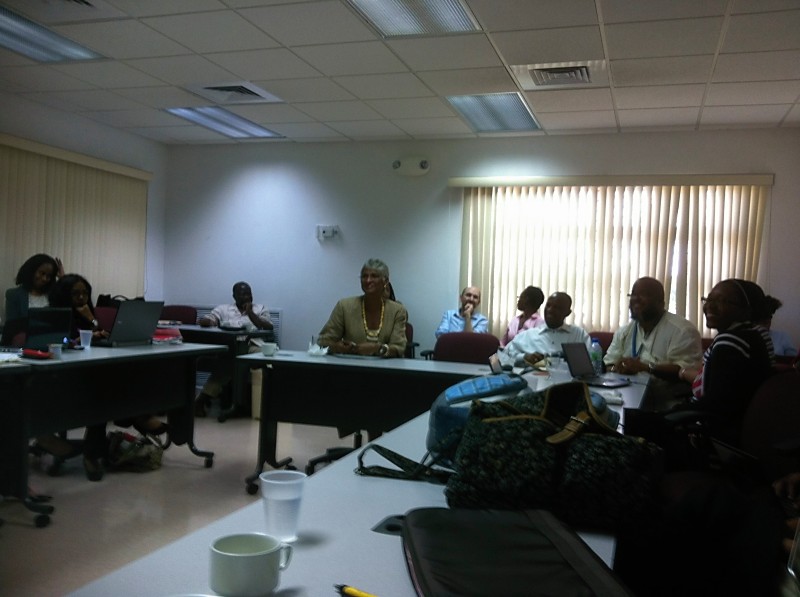 |
| CARICOM Ambassador and negotiation coaches in the classroom at UWI Cave Hill, Barbados |
This was an incredible learning experience: I gained experience managing people, creating and pursuing a vision, learning which negotiating tactics to avoid and employ, and balancing priorities in our mandate. Representing the underdog in a negotiation is an upward battle, but by employing the right tactics we made significant gains. On the last day of the negotiation, we presented our Economic Development Agreement to the Ambassador of CARICOM and their Agriculture representative. They took notes and asked excellent questions about how we pitched and balanced our priorities. They were impressed with the overall structure of the agreement. Real life free trade negotiations between Canada and CARICOM are stalled, and CTPL and the Department of Foreign Affairs have asked the students to report back about our creative solutions and problem solving skills. We all learned so much in a short week and I have emerged with new friends and colleagues. Here is a press release about the Economic Development Agreement we concluded.
Monday, May 16, 2011
Hey, Rapunzel, what's your Facebook (TM) status?

California is considering a bill that would give parents access to their children's Facebook (TM) pages. From the article, I think there are more weaknesses than strengths to the proposed bill. I agree that the security settings should default to most secure. I have a list of weaknesses however.
First, parents would supposedly have to ask Facebook to remove content only and it appears to only deal with text, not photos or apps (personally, the idiotic apps and comments my eleven year old cousin disseminates reflect more ridiculously than her atrociously spelled updates). Would the override extend to the "Account" in addition to the "Page"? Could a parent be able to manipulate more than just content? There is also no mention of whether or how the parent's reach would change once the child would become of age, whether Facebook monitors the child's coming of age, or whether the content is completely destroyed or merely cached & stored on a FB server (potentially outside the parent's own jurisdiction, ie California). Facebook also sounds like it would be surrendering its proprietary rights over the posted content to parents, which is inconsistent (and unfair) to the proprietary rights it maintains over other users' content. Finally, there does not seem to be a mechanism (other than charging someone with fraud) to prevent one from posing as a parent to gain access to another's Facebook page.
This raises interesting questions about Lisa Austin's individual right to self-presentation (Austin 2010)* as well as invasions of privacy and trespass. As we've seen, torts of invasion of privacy are recognized in some circumstances and not others and court orders impeding accessing an individual's Facebook page have been upheld. I think it may be recognized in this case, although the arguments for child safety may stymie them. I think some of the comments make good points about the need to be an involved parent, but one who doesn't need to rely on indirect channels to parent their kids. What I do find troubling is the automatic assumption that children deserve reduced privacy. I come from the perspective that treating kids with dignity, respect and integrity ensures positive communication that would render moot the need for asking Facebook for more control. I guess I also think that the steps taken depend on the age of the child/adolescent.
Photo credit: Rapunzel in the castle from Johnny Gruelle's illustration for the Gutenberg Project, Wikimedia Commons 2011. The image is fitting because Rapunzel was trapped by her witch-mother in a castle and told the world was a scary place to be and that the only person she could trust was her controlling mother. Unfalsifiable, clearly.
* Lisa Austin, "Privacy and the Private Law: The Dilemma of Justification," (2010) 55 McGill L J 165 at 203.
Tuesday, February 22, 2011
Summarizing history
On February 10th, I volunteered to report on history as it unfolded in an Ontario Superior Court of Justice courtroom on a freezing cold Ottawa afternoon.
The Canadian Centre for International Justice (CCIJ) canvassed the University listserv for volunteers to follow and report on the Mungwarere Trial. Jacques Mungwarere was charged with committing genocide during the Rwandan Genocide. He was located near Windsor, ON, in 2009. Following the prosecution of Desire Munyaneza, he is the second person to be prosecuted in Canada under the Crimes Against Humanity and War Crimes Act (Department of Justice).
The first week was an intense week of procedural motions and on Monday, February 11th, the Crown was scheduled to move for an indictment. It was an exciting opportunity to witness the practice of international law firsthand and to apply (and learn the French equivalents of) some of the legal terms I learned over the last few months. Students listened to the proceedings in pairs and then prepared a summary. It was a great learning and mentoring opportunity that also enabled me to contribute to the CCIJ's important work.
The Canadian Centre for International Justice (CCIJ) canvassed the University listserv for volunteers to follow and report on the Mungwarere Trial. Jacques Mungwarere was charged with committing genocide during the Rwandan Genocide. He was located near Windsor, ON, in 2009. Following the prosecution of Desire Munyaneza, he is the second person to be prosecuted in Canada under the Crimes Against Humanity and War Crimes Act (Department of Justice).
The first week was an intense week of procedural motions and on Monday, February 11th, the Crown was scheduled to move for an indictment. It was an exciting opportunity to witness the practice of international law firsthand and to apply (and learn the French equivalents of) some of the legal terms I learned over the last few months. Students listened to the proceedings in pairs and then prepared a summary. It was a great learning and mentoring opportunity that also enabled me to contribute to the CCIJ's important work.
Thursday, January 20, 2011
Shipping Rates and the end of cheap oil
Shipping rates have increased drastically recently. I purchase my gifts online and generally look for the estimated cost of shipping to factor into my price. Using online market places like Amazon make it easy and relatively convenient, except when it comes to international shipping rates. Those babies just pop up at the end of the transaction. Surprise! An extra 50$ on your order. I alternate between using my co.uk, .com, and .ca accounts to see where I can get the most savings, both on product price and shipping. However, then I am hit with a 5$ international transaction charge by my credit card. It is beyond me how they can charge me on top of the price I am already paying. The sellers have agreements with credit card companies to use online credit card payment services in the first place. There is still little difference in price for me, which means shipping has gone up substantially in the last 4 years since I started using Amazon. US sellers advertise in canadian dollars at higher prices despite the equal exchange rate and the Canadian purchaser is stuck with import duties and higher shipping prices. Where are the rising tides, Smith? What happened to the fruits of globalization and NAFTA where goods would move freely and consumers would have a choice about shipping rates? Even standard shipping is ridiculous. One seller quoted a 30-40 week estimation for a book. This past Christmas, instead of ordering a gift online, I returned to my local retailer where I paid the same price for the product without double the cost of shipping. If more customers think like me, online shopping revenues should decrease. Convenience is coming at a higher price and I predict a return to an era of localization and the end of online shopping as we know it.
Sunday, January 16, 2011
Why Chinese Mothers are Superior WSJ 8 Jan 2011
Amy Chua's article, (http://online.wsj.com/article/SB10001424052748704111504576059713528698754.html), has sparked a debate in the Wall Street Journal, as well as in parenting and psychology literature. There is an articulate rebuttal by a Jewish mother http://abcnews.go.com/Health/jewish-author-responds-wsj-chinese-mothering-controversy/story?id=12623592. Parents have a hard job and as this psychologist suggests, : http://www.psychologytoday.com/blog/what-the-wild-things-are/201101/chinese-parent-western-parent-superior-parent-have-we-figured-i, a balance between disciplinarians and laissez-faire is necessary for optimal results
As someone who was raised with "Asian values" along what I will call a cultural faultline (Caucasian-caribbean-indian) and lived to tell the tale, the story she tells is pretty accurate (minus the 3 hours of piano a night), but one-sided. The problem with her model is that it is traumatic for children to live with the culture-bashing, allegations of assimilation and berating between parents and parents and children. Is it worth it to yell til you're hoarse just to demonstrate to the world that you can mimic antiquated hallmarks of elitism? I don't think so. And when does telling your daughter "stop eating so much fatty" stop exactly? From my experience it doesn't because those horrible things live on long after they're said and because parents have diffculty distinguishing their grown 22 year old daughter from the 7 year old in their mind, they feel like they can 1. always say those things and 2. get away without consequences from saying those things because of parental immunity. Kids in this environment grow up accepting and not questioning until they are pushed to their limit; living in perpetual fear, irrationally seeking control, and self-flagellating with blame and guilt. This manifests itself in eating disorders, higher suicide rates between the ages of 15-24 (as the rebuttal cites), obsessions with materialism, and an inability to adapt and deal with the chaos intrinsic to human life. By understanding the cultural differences and deconstructing them, I have overcome this behaviour and have banished the shame and silence it requires to be effective. There are constructive ways to raise children to be determined, thoughtful, self-sufficient confident members of society, and this isn't it. What's more is all that yelling is in vain: the parenting research illustrates that parenting has very little to do with how your child turns out; personality and friends determine that, and forbidding friends, striking down sense of self-worth have the reverse effect (ie. kids go running to the wrong types of people who give them what they can't get at home). Secondly, in order to curb adolescent rebellion and inspire self-sufficiency, we need to give children a meaningful stake in contributing to society.
Also striking to me is her willing stereotypical bifurcation of cultures, although she tries to smooth it out by combining Asian values with Indian, Caribbean and irish values. But these mothers exist in all races, in all cultures in all eras and I think she sets up a straw man argument that is easily dismantled with ethnography and longitudinal surveys.
Finally, I think parents should be aware of the assault scheme in Canadian criminal law if they are going to use some of the tactics advocated by Ms. Chua. Section 265 of the Criminal Code states:
265. (1) A person commits an assault when
(a) without the consent of another person, he applies force intentionally to that other person, directly or indirectly;
(b) he attempts or threatens, by an act or a gesture, to apply force to another person, if he has, or causes that other person to believe on reasonable grounds that he has, present ability to effect his purpose; or
(c) while openly wearing or carrying a weapon or an imitation thereof, he accosts or impedes another person or begs.
Application
(2) This section applies to all forms of assault, including sexual assault, sexual assault with a weapon, threats to a third party or causing bodily harm and aggravated sexual assault.
Consent
(3) For the purposes of this section, no consent is obtained where the complainant submits or does not resist by reason of
(a) the application of force to the complainant or to a person other than the complainant;
(b) threats or fear of the application of force to the complainant or to a person other than the complainant;
(c) fraud; or
(d) the exercise of authority.
Accused's belief as to consent
(4) Where an accused alleges that he believed that the complainant consented to the conduct that is the subject-matter of the charge, a judge, if satisfied that there is sufficient evidence and that, if believed by the jury, the evidence would constitute a defence, shall instruct the jury, when reviewing all the evidence relating to the determination of the honesty of the accused's belief, to consider the presence or absence of reasonable grounds for that belief.
Appealing to parental authority is not a defence, as evidenced by subsection 3(d). Furthermore, parents should also keep the principles outlined by the Supreme Court in Canadian Foundation for Children, youth and The Law v. Canada in mind when punishing children. Punishment or parental strongarming must be corrective but reasonable and not be "outbursts of violence motivated by anger or animated by frustration" and must be the "education or discipline of the child". The child must be able to benefit from the application of force; if incapable of doing so, the application of force is void. Any force, verbal or physical, must be reasonable. Parents can also be sued for battery and negligence for tortious conduct in childrearing. Parents should and must be accountable for the choices they make in raising their children and I disagree with the parental immunity Chau implies and supports. The International Covenant on Civil and Political Rights and Article 37 of the Convention on the Rights of the Child "requires state parties to ensure that '[n]o chld shall be subjected to torture or other cruel, inhuman or degrading treatment or punishment." These are important limits and guidelines for parents to remember as they impose their own limits and guidelines on their children.
Wednesday, May 26, 2010
Bilingualism of Supreme Court Justices
The debate about possible limits of Canada's bilingualism laws has re-emerged in the debate over its Supreme Court justices. Lysianne Gagnon published an article in the Globe and Mail about the potential problems with the proposed legislation that would compel SCC judges to be bilingual, or limit appointments to bilingual candidates.
The SCC judges are currently appointed and hold the post until the age of 75.
The SCC judges are currently appointed and hold the post until the age of 75.
Subscribe to:
Posts (Atom)