Monday, March 26, 2012

Hey Dundonald Park advocates, throw us a bone!

Trash can at the corner of McLaren & Bay St. Photo Credit: Jim Davies
I recently read Dorian Panchyson's article in the Centretown Buzz about a community effort to revitalize Dundonald Park. I think the first place to start is to change the way dogs and, de facto,  dog owners, are treated in the park. Dog owners, as well as tai chi practitioners, people enjoying a sunny day on a park bench, homeless people, bocci players, chess players and daily commuters use this park on a regular basis.  Dundonald Park is an oasis of neighbourly-ness in the urban core that has few greenspaces. Since becoming a dog owner in 2008, I consistently look forward to walking my dog, Mrs. Wiggles, to meet up with fellow dog walkers and passers-by; many of whom have become friends of mine.

Mrs. Wiggles in February 2011. Photo Credit: Sean Toomey. Throw the dog a bone and give  her a place to walk or run freely. And maybe another little boot.


However, the tone established in the park is one of prohibition. I think it's in the same spirit as the Safe Streets Act, which attempts to overregulate public space for the elusive goal of "protecting the public".

Observe and Report! The world is clearly going to the dogs! Photo credit: Vanessa Davies; courtesy of  ottawa.ca


At each corner of the park, there is a trashcan marked "Do not deposit dog waste here." I appreciate the City of Ottawa's effort to clean up the park, but I think the plan is aimed at the wrong end, so to speak. I think the internal logic is that if people are prohibited from disposing their trash, they won't bring their dogs here. The evidence (twice daily walks to the park 10 months of the year) dictates the plan is a failure, because lots of people walk their dog and pick up after it. Frankly, I think the prohibition on depositing dog waste aims to punish the few owners who neglect to pick up after their pet, but in fact punishes us all unfairly and makes us feel unwelcome in our local park. It also raises the question, "if not in the only 4 trash receptacles in the park, where else do I deposit the waste of the loyal animal for whom I care and who I consider part of my family?" I ignore the ban and simply put the trash in the receptacle because to leave it on the ground would be illegal and unethical; to carry it several blocks would be unreasonably onerous. There need to be more trashcans downtown anyways, so discouraging people to use the ones that are there turns the City's aim of "cleaning the capital" on its head.

So, please, throw us a bone by taking down the prohibition signs on the trashcans, installing more trash cans - if they're not being installed because they're unsightly, then get a sculptor like Theo Pelmus to design them and make them into functional public art - before we pave paradise and put up another parking lot.

Sunday, March 4, 2012

Access Denied: "Migration, 'Illegality', and Health: Mapping Embodied Vulnerability and Debating Health-Related Deservingness."

My acquaintances at Access Denied have a special issue this month: "Migration, 'Illegality', and Health: Mapping Embodied Vulnerability and Debating Health-Related Deservingness."

The Table of Contents for this interdisciplinary guest-edited collection is pasted below, and the full volume is accessible online athttp://www.sciencedirect.com/science/journal/02779536.


Congratulations, and please circulate widely.


Friday, February 17, 2012

Black History Month

My friend who is living in London and completing her PhD at LSE saw these in Walgreens recently. On the one hand, one could say that this was unconscious racism; on the other this was probably an oversight and a thoughtless, inconsiderate act rather than a malicious one. Slavery, racism, apartheid - these are travesties that ravage human history, and recent ones, too. They are also fresh wounds for some people on a daily basis. In the spirit of Black History month, let us work on challenging and vanquishing our prejudices, but also on vanquishing thoughtlessness and inconsideration.

Wednesday, February 8, 2012

First Conference Paper Accepted

I was notified yesterday that my submission, "Enforcing a Reasonable Expectation of Privacy in Public: Online disclosure and contextual integrity", was accepted to the Windsor Review of Legal and Social IssuesCanadian Law Students' Conference. The paper highlights fault lines between values of government transparency and personal privacy using the examples from the Prop 8 debate in California and the harassment of BNP supporters in the UK. It then argues that violating the contextual integrity of material posted online in such a way as to incite harassment falls within hate crime or human rights legislation and should be prosecuted accordingly, rather than inventing new laws to deal with technology that facilitates this kind of behaviour. 


The conference will be held March 15-16 in Windsor, ON, and I am looking forward to presenting my ideas.

Tuesday, January 31, 2012

New experiences, brighter futures

It has been 9 months since my last post. It was not a result of being too busy or neglectful or unstimulated, but the result of doing client work that required me to keep a lower profile. As a law student I am bound by solicitor-client privilege and regulated by the Law Society of Upper Canada.

The January semester was one of discovery for me. I discovered the thrill of international trade law. I took a 3 week course in International Trade Negotiation taught by the Centre for Trade Law and Policy housed in Carleton University. The first two weeks of the course covered substantive trade in goods and services as well as negotiation techniques. The last week involved a simulation with students at the University of the West Indies in Cave Hill, Barbados. I had heard about the course in December 2010 and saved my summer earnings and successfully registered by lottery in July. I took my friend, Alicia, who is not a law student and we stayed at the Almond Beach Club and Spa in St. James, a mere 8 minute bus ride (on a yellow, calypso-blaring bus - awesome way to start the morning!) to the University.

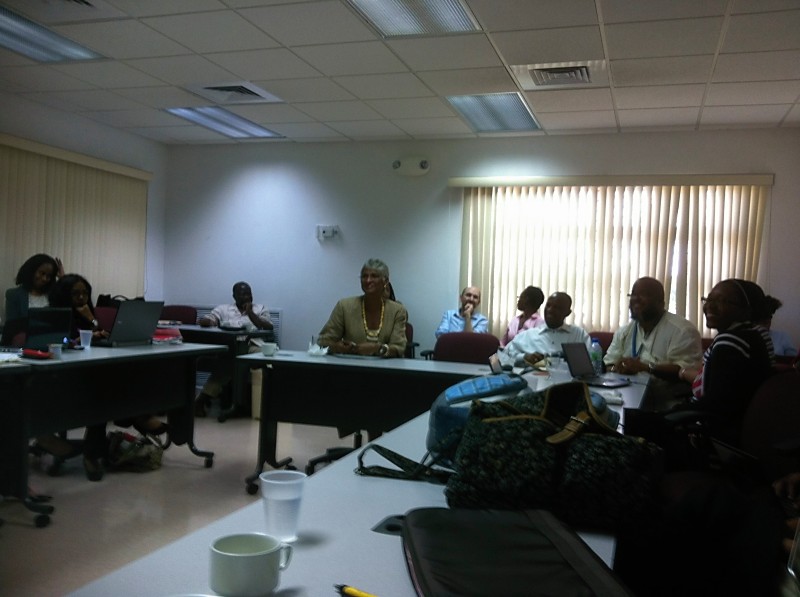
Jeanelle Clarke, Alicia Breck and Vanessa Davies after the negotiation
There have been a few TED talks that have resonated with me over the Fall semester and I crystallized their messages during this negotiation. The most influential was Sheryl Sandberg's talk about too few women leaders. Because of her, I consciously decided to "sit at the table" and "keep my hand raised". I was the only person on my team, the CARICOM (stands for Caribbean Community, a single market economic trading area) team, to put my candidacy forward for Chief Negotiator. Because I did so, my team sensed my leadership skills and unanimously supported me. The course was largely female-dominated and there are distinct social tensions that arise with female leaders. I eschewed them by supporting my teammates' ideas, listening supportively, giving credit where it was due, keeping them part of any strategizing I did and commending them at the end of each of the four days we were together. As a result, we worked better together which enabled us to make significant gains in our negotiation against the team representing Canada. I also employed similar strategies when dealing with the other Chief Negotiator, which defused tensions that arose in the plenary sessions. I was straightforward with concerns, we shared personal stories, I was not afraid to ask questions or seek clarification. It became apparent to me that "Canada's" Chief Negotiator was on our side and could meet many of our needs if we were to frame it creatively. So I went back to my team having cultivated trust on both sides in order to brainstorm better solutions.
CARICOM Ambassador and negotiation coaches in the classroom at UWI Cave Hill, Barbados

This was an incredible learning experience: I gained experience managing people, creating and pursuing a vision, learning which negotiating tactics to avoid and employ, and balancing priorities in our mandate. Representing the underdog in a negotiation is an upward battle, but by employing the right tactics we made significant gains. On the last day of the negotiation, we presented our Economic Development Agreement to the Ambassador of CARICOM and their Agriculture representative. They took notes and asked excellent questions about how we pitched and balanced our priorities. They were impressed with the overall structure of the agreement. Real life free trade negotiations between Canada and CARICOM are stalled, and CTPL and the Department of Foreign Affairs have asked the students to report back about our creative solutions and problem solving skills. We all learned so much in a short week and I have emerged with new friends and colleagues. Here is a press release about the Economic Development Agreement we concluded.

Monday, May 16, 2011

Hey, Rapunzel, what's your Facebook (TM) status?

California is considering a bill that would give parents access to their children's Facebook (TM) pages. From the article, I think there are more weaknesses than strengths to the proposed bill. I agree that the security settings should default to most secure. I have a list of weaknesses however. 

First, parents would supposedly have to ask Facebook to remove content only and it appears to only deal with text, not photos or apps (personally, the idiotic apps and comments my eleven year old cousin disseminates reflect more ridiculously than her atrociously spelled updates). Would the override extend to the "Account" in addition to the "Page"? Could a parent be able to manipulate more than just content? There is also no mention of whether or how the parent's reach would change once the child would become of age, whether Facebook monitors the child's coming of age, or whether the content is completely destroyed or merely cached & stored on a FB server (potentially outside the parent's own jurisdiction, ie California). Facebook also sounds like it would be surrendering its proprietary rights over the posted content to parents, which is inconsistent (and unfair) to the proprietary rights it maintains over other users' content. Finally, there does not seem to be a mechanism (other than charging someone with fraud) to prevent one from posing as a parent to gain access to another's Facebook page.

This raises interesting questions about Lisa Austin's individual right to self-presentation (Austin 2010)* as well as invasions of privacy and trespass. As we've seen, torts of invasion of privacy are recognized in some circumstances and not others and court orders impeding accessing an individual's Facebook page have been upheld. I think it may be recognized in this case, although the arguments for child safety may stymie them. I think some of the comments make good points about the need to be an involved parent, but one who doesn't need to rely on indirect channels to parent their kids. What I do find troubling is the automatic assumption that children deserve reduced privacy. I come from the perspective that treating kids with dignity, respect and integrity ensures positive communication that would render moot the need for asking Facebook for more control. I guess I also think that the steps taken depend on the age of the child/adolescent. 

Photo credit: Rapunzel in the castle from Johnny Gruelle's illustration for the Gutenberg Project, Wikimedia Commons 2011. The image is fitting because Rapunzel was trapped by her witch-mother in a castle and told the world was a scary place to be and that the only person she could trust was her controlling mother. Unfalsifiable, clearly.

* Lisa Austin, "Privacy and the Private Law: The Dilemma of Justification," (2010) 55 McGill L J 165 at 203.

Tuesday, February 22, 2011

Summarizing history

On February 10th, I volunteered to report on history as it unfolded in an Ontario Superior Court of Justice courtroom on a freezing cold Ottawa afternoon.

The Canadian Centre for International Justice (CCIJ) canvassed the University listserv for volunteers to follow and report on the Mungwarere Trial. Jacques Mungwarere was charged with committing genocide during the Rwandan Genocide. He was located near Windsor, ON, in 2009. Following the prosecution of Desire Munyaneza, he is the second person to be prosecuted in Canada under the Crimes Against Humanity and War Crimes Act (Department of Justice).

The first week was an intense week of procedural motions and on Monday, February 11th, the Crown was scheduled to move for an indictment. It was an exciting opportunity to witness the practice of international law firsthand and to apply (and learn the French equivalents of) some of the legal terms I learned over the last few months. Students listened to the proceedings in pairs and then prepared a summary. It was a great learning and mentoring opportunity that also enabled me to contribute to the CCIJ's important work.

Thursday, January 20, 2011

Shipping Rates and the end of cheap oil

Shipping rates have increased drastically recently. I purchase my gifts online and generally look for the estimated cost of shipping to factor into my price. Using online market places like Amazon make it easy and relatively convenient, except when it comes to international shipping rates. Those babies just pop up at the end of the transaction. Surprise! An extra 50$ on your order. I alternate between using my co.uk, .com, and .ca accounts to see where I can get the most savings, both on product price and shipping. However, then I am hit with a 5$ international transaction charge by my credit card. It is beyond me how they can charge me on top of the price I am already paying. The sellers have agreements with credit card companies to use online credit card payment services in the first place. There is still little difference in price for me, which means shipping has gone up substantially in the last 4 years since I started using Amazon. US sellers advertise in canadian dollars at higher prices despite the equal exchange rate and the Canadian purchaser is stuck with import duties and higher shipping prices. Where are the rising tides, Smith? What happened to the fruits of globalization and NAFTA where goods would move freely and consumers would have a choice about shipping rates? Even standard shipping is ridiculous. One seller quoted a 30-40 week estimation for a book.  This past Christmas, instead of ordering a gift online, I returned to my local retailer where I paid the same price for the product without double the cost of shipping. If more customers think like me, online shopping revenues should decrease. Convenience is coming at a higher price and I predict a return to an era of localization and the end of online shopping as we know it.

Sunday, January 16, 2011

Why Chinese Mothers are Superior WSJ 8 Jan 2011


Amy Chua's article, (http://online.wsj.com/article/SB10001424052748704111504576059713528698754.html),  has sparked a debate in the Wall Street Journal, as well as in parenting and psychology literature. There is an articulate rebuttal by a Jewish mother http://abcnews.go.com/Health/jewish-author-responds-wsj-chinese-mothering-controversy/story?id=12623592. Parents have a hard job and as this psychologist suggests, : http://www.psychologytoday.com/blog/what-the-wild-things-are/201101/chinese-parent-western-parent-superior-parent-have-we-figured-i, a balance between disciplinarians and laissez-faire is necessary for optimal results

As someone who was raised with "Asian values" along what I will call a cultural faultline (Caucasian-caribbean-indian) and lived to tell the tale, the story she tells is pretty accurate (minus the 3 hours of piano a night), but one-sided. The problem with her model is that it is traumatic for children to live with the culture-bashing, allegations of assimilation and berating between parents and parents and children. Is it worth it to yell til you're hoarse just to demonstrate to the world that you can mimic antiquated hallmarks of elitism? I don't think so. And when does telling your daughter "stop eating so much fatty" stop exactly? From my experience it doesn't because those horrible things live on long after they're said and because parents have diffculty distinguishing their grown 22 year old daughter from the 7 year old in their mind, they feel like they can 1. always say those things and 2. get away without consequences from saying those things because of parental immunity. Kids in this environment grow up accepting and not questioning until they are pushed to their limit; living in perpetual fear, irrationally seeking control, and self-flagellating with blame and guilt. This manifests itself in eating disorders, higher suicide rates between the ages of 15-24 (as the rebuttal cites), obsessions with materialism, and an inability to adapt and deal with the chaos  intrinsic to human life. By understanding the cultural differences and deconstructing them, I have overcome this behaviour and have banished the shame and silence it requires to be effective. There are constructive ways to raise children to be determined, thoughtful, self-sufficient confident members of society, and this isn't it. What's more is all that yelling is in vain: the parenting research illustrates that parenting has very little to do with how your child turns out; personality and friends determine that, and forbidding friends, striking down sense of self-worth have the reverse effect (ie. kids go running to the wrong types of people who give them what they can't get at home). Secondly, in order to curb adolescent rebellion and inspire self-sufficiency, we need to give children a meaningful stake in contributing to society.

Also striking to me is her willing stereotypical bifurcation of cultures, although she tries to smooth it out by combining Asian values with Indian, Caribbean and irish values. But these mothers exist in all races, in all cultures in all eras and I think she sets up a straw man argument that is easily dismantled with ethnography and longitudinal surveys.

Finally, I think parents should be aware of the assault scheme in Canadian criminal law if they are going to use some of the tactics advocated by Ms. Chua. Section 265 of the Criminal Code states:


265. (1) A person commits an assault when
(a) without the consent of another person, he applies force intentionally to that other person, directly or indirectly;
(b) he attempts or threatens, by an act or a gesture, to apply force to another person, if he has, or causes that other person to believe on reasonable grounds that he has, present ability to effect his purpose; or
(c) while openly wearing or carrying a weapon or an imitation thereof, he accosts or impedes another person or begs.


Application
(2) This section applies to all forms of assault, including sexual assault, sexual assault with a weapon, threats to a third party or causing bodily harm and aggravated sexual assault.


Consent
(3) For the purposes of this section, no consent is obtained where the complainant submits or does not resist by reason of
(a) the application of force to the complainant or to a person other than the complainant;
(b) threats or fear of the application of force to the complainant or to a person other than the complainant;
(c) fraud; or
(d) the exercise of authority.


Accused's belief as to consent
(4) Where an accused alleges that he believed that the complainant consented to the conduct that is the subject-matter of the charge, a judge, if satisfied that there is sufficient evidence and that, if believed by the jury, the evidence would constitute a defence, shall instruct the jury, when reviewing all the evidence relating to the determination of the honesty of the accused's belief, to consider the presence or absence of reasonable grounds for that belief.

Appealing to parental authority is not a defence, as evidenced by subsection 3(d). Furthermore, parents should also keep the principles outlined by the Supreme Court in Canadian Foundation for Children, youth and The Law v. Canada in mind when punishing children. Punishment or parental strongarming must be corrective but reasonable and not be "outbursts of violence motivated by anger or animated by frustration" and must be the "education or discipline of the child". The child must be able to benefit from the application of force; if incapable of doing so, the application of force is void. Any force, verbal or physical, must be reasonable. Parents can also be sued for battery and negligence for tortious conduct in childrearing. Parents should and must be accountable for the choices they make in raising their children and I disagree with the parental immunity Chau implies and supports.  The International Covenant on Civil and Political Rights and Article 37 of the Convention on the Rights of the Child  "requires state parties to ensure that '[n]o chld shall be subjected to torture or other cruel, inhuman or degrading treatment or punishment." These are important limits and guidelines for parents to remember as they impose their own limits and guidelines on their children.

Wednesday, May 26, 2010

Bilingualism of Supreme Court Justices

The debate about possible limits of Canada's bilingualism laws has re-emerged in the debate over its Supreme Court justices. Lysianne Gagnon published an article in the Globe and Mail about the potential problems with the proposed legislation that would compel SCC judges to be bilingual, or limit appointments to bilingual candidates.

The SCC judges are currently appointed and hold the post until the age of 75.

Wednesday, April 21, 2010

Law School

On Monday, April 19, I was offered admission to the University of Ottawa Faculty of Law's English Common Law Program, to commence studies in Fall 2010.

This is a prestigious programme with incredible opportunities to grow, including the opportunity to pursue a joint Juris Doctorate program in the United States.

I am extremely excited about embarking on this new phase in my career.

Saturday, February 27, 2010

Democracy in Africa and its effect on Refugees

 
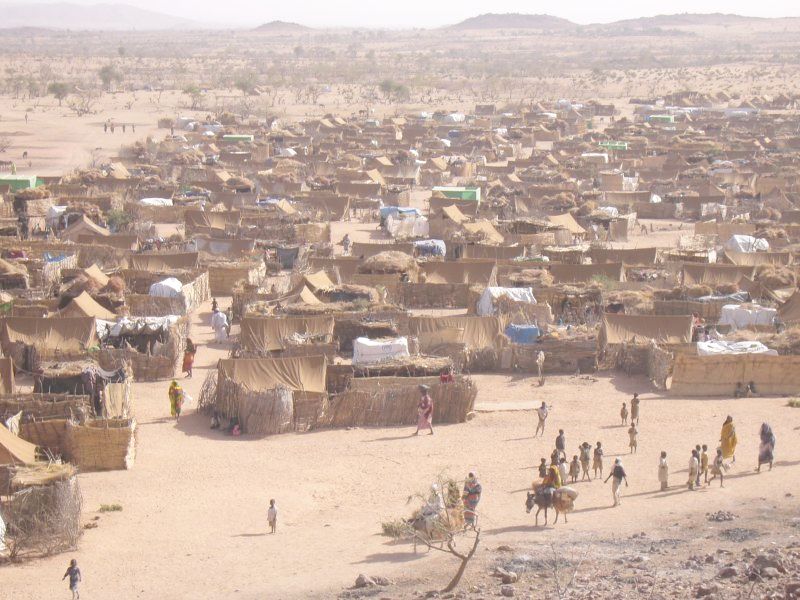
Photo of Darfur Refugee Camp in Chad, taken by Mark Knobil, 2005 via Wikimedia Commons

I attended a talk recently by Professor James Milner at Carleton University which examined how responses to refugees varied before and after the end of the Cold War. The lecture is part of  a series hosted by the Political Science department which examines how the world has changed since the end of the Cold War.

The aspect I found most profound in his talk was the effect of democratic transition in African countries  on protracted refugee situations within countries, such as Tanzania. Protracted refugee situations have been used as leverage in political campaigns. As quickly as one leader can promise expulsion to garner a majority of votes, thus scapegoating refugees - many of whom only know life in a camp - another leader uses the opposite rhetoric and hands out citizenship in mass ceremonies, clearly admitting that refugee populations have significant and meaningful contributions and ties to a particular region. I came away curious about the arbitrary choices between expulsion and naturalization that some of these countries demonstrate. If it's so easy to naturalize citizens, why isn't it a widespread practice? What does naturalization actually mean for the refugees who have spent one or two generations in a camp? How are they, in fact, received by host populations? What are the economic calculations, if any, to naturalize, deport, or resettle refugees? I believe these are the questions we need to be seriously considering as we reconsider  the future of the refugee regime and the inadequacy of present responses in light of changing characteristics of forced migration.

One sinister theme that emerged from Professor Milner's presentation was the growing restrictions, including freedom of mobility within the receiving country,  guaranteed by the 1951 Convention Relating to the Status of Refugees. Less developed countries follow the example of developed countries and impose stringent and illegal restrictions on Convention refugees. The disturbing pre-emptive measures (such as carrier restrictions, interception, and extraterritoriality meaning that you have to be cleared by an embassy in your home country and not crossing an international border which is central to the 1951 Convention definition of a 'refugee') taken by such countries as Canada, the UK, the US and the EU to restrict flows of refugees has been extrapolated in such places as Thailand and Tanzania so that refugees are under lock-down situations in contravention of international law.
 
This photograph is of a United States Coast Guard cutter, that intercepted and transported the Haitian refugees who fled the turmoil in their country, in the port at the U.S. Naval Base at Guantanamo Bay, Cuba in 1992. More than 14,000 refugees attempted to reach the United States by boat and were picked up by the Coast Guard in international waters and transported to the base at Guantanamo Bay. Courtesy of Wikimedia images - this image was taken by a US Official during  duty and is therefore in the public domain.

Friday, January 29, 2010

SCC Decision on Omar Khadr

Today, the Supreme Court of Canada overturned what could have led to the repatriation of Omar Khadr from the Guantanamo Bay detention centre where he has been held for more than 6 years. (CBC News).

While deeply dismayed at the continuing injustice, what the SCC called Khadr's "[continued violation] of rights to life, liberty and security of person", the SCC reflected an hesitation to overstep its jurisdiction. It concluded that the precedent of forcing the government to overstep its boundaries in international relations outweighed Khadr's Article 1 Charter rights. The SCC outlined the severity and urgency of the situation, as well as the initial violation of Khadr's rights at the initial stages of interrogation including the exchange of information to American authorities that resulted in his imprisonment in Guantanamo Bay. There is late-blooming public outcry to release Khadr from US custody and have him tried in Canada. It is hoped that the government, in light of the evidence, will make the decision to return Khadr to Canada.

There are disturbing implications for the SCC decision. First, in light of questionable interrogation tactics, charges of torture, extraordinary rendition and the persistence of the death penalty, it is shocking that Canada would have handed over Khadr to American authorities, let alone allow him to remain in their custody. The arguments articulated in opposition to the Safe Third Country Agreement are absent in this case it would seem. It is hypocritical that Canada maintains its reputation as a refuge from US extradition for Americans facing the death penalty or the draft, while simultaneously refusing to help one of its own citizens - regardless of his actions.

Secondly, there has been little or no action taken on the basis that Khadr was charged as a minor and should, therefore, be entitled to be treated as such, including protection under laws governing the rehabilitation and prosecution of child soldiers, in accordance with the principles set out in the UN Convention on the Rights of the Child.

Third, the government's inaction, similar to the inaction on the Kazemi and Arar cases, is a further reminder that no Canadian anywhere or at anytime can be assured of their protection by Canadian authorities overseas. Furthermore, the indication that the Khadr case will continue to be a political football flies in the face of our civic values and demonstrates the shameless self-promotion of Canada's political parties.

One wonders at the ability of the SCC to, on the one hand, strike down the use of security certificates but draw the line at Khadr.

The Supreme Court decision indicates that balance of power is alive and well in Canada, and that healthy debate about the future of human rights and civic values is still to come. This is coming at a very high cost to the action taken on human rights law. Similar to the Arar case, it seems like the Court is only delaying the inevitable reparations the Canadian government will have to make for the wrongful betrayal and imprisonment of one of its own by not sending a stronger message to the government to repatriate Omar Khadr.

Friday, January 22, 2010

New Horizons

It was a busy fall. With proroguement nigh, I am looking forward to getting back to working on resubmitting my Master's thesis for journal publication.

I submitted my law applications to seven schools in North America, so I should hear back in the Spring. I am hoping to specialize in Public International Law and/or Human Rights. With the applications under my belt, I am working on scholarship applications to offset the cost of law school.

I joined Amnesty International's RefNet in September and was pleased to assist with research on my first case over the holidays.

Tuesday, January 19, 2010

Mapping the Recession

This link was shared with me and I think it does such a great job at looking at how unemployment is spreading across the US that I wanted to share it.

http://www.youtube.com/watch?v=G9jBNyysbho&feature=player_embedded

Thursday, January 14, 2010

James Milner Speaks on Burundian Refugees in Tanzania

African Studies Brownbag Seminar Series talk, co-sponsored by the Ottawa Migration and Refugee Research Network (OMRRN):
"Understanding solutions for African refugees: The case of Burundians in Tanzania"
with
James Milner
Carleton University (Political Science/Institute of African Studies)
Wednesday, January 20 at 1:00- 2:30 pm
433 Paterson Hall, Carleton University
This is part of the African Studies Brownbag Seminar Series
(http://www.carleton.ca/africanstudies/)

Wednesday, January 13, 2010

Urgent Action

UA 10/10                                                                                              
AI Index: ASA 26/001/2010 of 13 January 2010

LAOS:  REFUGEES FORCIBLY RETURNED FROM THAILAND
The Thai authorities forcibly returned around 4,500 Lao Hmong, including 158 recognized refugees, to Laos at the end of 2009. The Lao government is refusing to permit UN and other monitors access to them.

On 28 and 29 December, the Thai military forcibly returned to Laos around 4,500 Lao Hmong, in breach of international law. Most had been in a camp in Phetchabun province. Some 158 recognized refugees arbitrarily detained in Nong Khai Immigration Detention Centre, near the Lao border, were also forcibly returned, despite offers from four other countries to accept them for resettlement.
The Thai and Lao governments had given assurances that the 158 would be resettled in third countries once they had transited through Laos. However on 10 January, a Lao government spokesperson told journalists that "all of the Hmong decided to live in their homeland forever," and no longer wanted to resettle abroad. At the same time the government is refusing all requests to give UN monitors unfettered access to the refugees, to assess their wellbeing and ensure that their wishes to resettle in third countries are considered.
The UN Refugee Agency UNHCR had verified that the 158 have a well-founded fear of persecution in Laos, and granted them refugee status. As the Thai government refused UNHCR access to the Phetchabun camp, it is not known how many people there had fled persecution and should therefore have been recognized as refugees.
Since 2005, forcible returns of Lao Hmong from Thailand have led to enforced disappearances, torture and arbitrary detention. The Lao government have consistently denied this, but have not provided any comprehensive information to support their claims or allowed independent monitors to investigate these reports.
Around 20 of the 158 refugees have been seen at a designated resettlement village, Phalak, around 70km north of the capital, Vientiane. The whereabouts of the others is not known. However, hundreds of returnees have been seen in what has been described as an army camp north of Paksan town, around 20km east of Vientiane. The returnees, mostly women and children, were not free to come and go from the facility, which was fenced in with razor wire.

PLEASE WRITE IMMEDIATELY in your own words, using English, Lao, French or your own language. Call on the authorities
* to allow UN monitors unfettered access to the returnees from Thailand immediately, whether or not they have refugee status;
* to honour their agreement to allow any refugees to settle in third countries;
* to expedite and help with any preparations required for third country resettlement;
* to allow those who choose to remain in Laos, rather than be resettled, to participate in decisions about their place of residence and livelihood;
* to ensure that none of the around 4,500 returnees are arbitrarily detained, tortured or subjected to enforced disappearance.

PLEASE SEND APPEALS TO:
Minister of Foreign Affairs:
Thongloun Sisoulit
Ministry of Foreign Affairs
That Luang Road, Vientiane, Laos
Fax:   011 856 21 414 009
Email:   cabinet@mofa.gov.la
Salutation:  Dear Minister
Minister of Justice:
Dr Chaleuan Yapaoher
Ministry of Justice
Lane Xang Avenue
Vientiane, Laos
Fax:   011 856 21 414 009 (This is c/o Ministry of Foreign Affairs)
Salutation:  Dear Minister
WITH A COPY TO
His Excellency Phiane Philakone
Ambassador for the Lao People's Democratic Republic
2222 S Street N.W.
Washington, DC 20008, USA
Fax:   (202) 332-4923
Email:   laoemb@verizon.net

ADDITIONAL INFORMATION
Around 5,000 Lao Hmong people, including an unknown number of asylum-seekers, had been living in a camp in Phetchabun, Thailand, since 2004. The vast majority did not have the opportunity to seek asylum. The Thai military returned them under an agreement between the Thai and Lao governments. Many of those who had been returned before this last group were sent to villages designated for people returned from abroad after going through "re-education". The Lao authorities have arranged several visits to Phalak resettlement site for diplomats and local journalists, but have refused to allow anyone to approach the returnees unaccompanied.
The group of 158 refugees forcibly returned to Laos, more than half of them children, had been arbitrarily detained at Nong Khai Immigration Detention Center for more than three years. The governments of Australia, Canada, the Netherlands and the USA had offered to accept them for resettlement, but the Lao authorities intervened with the Thai authorities to prevent this happening.
Most Hmong refugees and asylum-seekers in Thailand claim to have some connection to groups living in isolated pockets in the Lao jungles since the Viet Nam war ended in 1975.
Laos ratified the International Covenant on Civil and Political Rights (ICCPR) on 25 September 2009. This means they are obliged to guarantee all people in Laos the right to be free from torture,  to liberty of movement and freedom to choose their residence, and the rights to freedom of expression and assembly. They must also provide safeguards for the treatment of detainees.
The Lao Hmong asylum-seekers were previously the subject of UA 324/06 (ASA 39/017/2006), 29 November 2006, and follow-ups.

Urgent Action Office   Amnesty International Canada  
1992 Yonge St, 3rd floor   Toronto, Ontario M4S 1Z7
(416) 363 9933 ext 325   /   Fax (416) 363 3103   /  
www.amnesty.ca/urgentaction

Saturday, October 17, 2009

AIDSLEX.org


I am a member of the HIV/AIDS Legal Network. The Network recently launched a database of experts and information for those working on the multiple facets of HIV/AIDS. Check it out if you need answers to questions about AIDS, law, drugs, access and human rights.


www.aidslex.org


If you would like to know more about the work of the HIV/AIDS Legal Network, click here.

Tuesday, October 13, 2009

Don't Waste Student Work

I saw this talk recently and wish so much that I could have furthered projects that reached a wider audience. I can't think of the vast number of summaries I had to produce for courses during my undergraduate degree, all of which did nothing other than to make me aware of an argument or fact and give my evaluator an even playing field to evaluate students.